

Enterprise
Honeywell's Forge Cognition Cuts False Security Alarms 90% at NVIDIA's Voyager Campus
Honeywell Technologies launched an agentic AI platform for facility operations on October 14, partnering with NVIDIA and Dell Technologies to combine real-time digital twins with autonomous building agents.
Mainstay Communications Team · · 3 min read
In brief
Honeywell Technologies unveiled Forge Cognition on October 14, 2026, a platform that pairs AI agents with live digital twins to manage building systems across security, heating, cooling, and power. A 90-day pilot at NVIDIA's 750,000-square-foot Voyager headquarters in Santa Clara cut unnecessary security alarms by up to 90% and identified close to 10% in potential energy savings. The platform's autonomous mode is deliberately disabled for now, with Honeywell's CTO estimating a 2-to-3-year timeline before full AI decision authority goes live.
The Platform
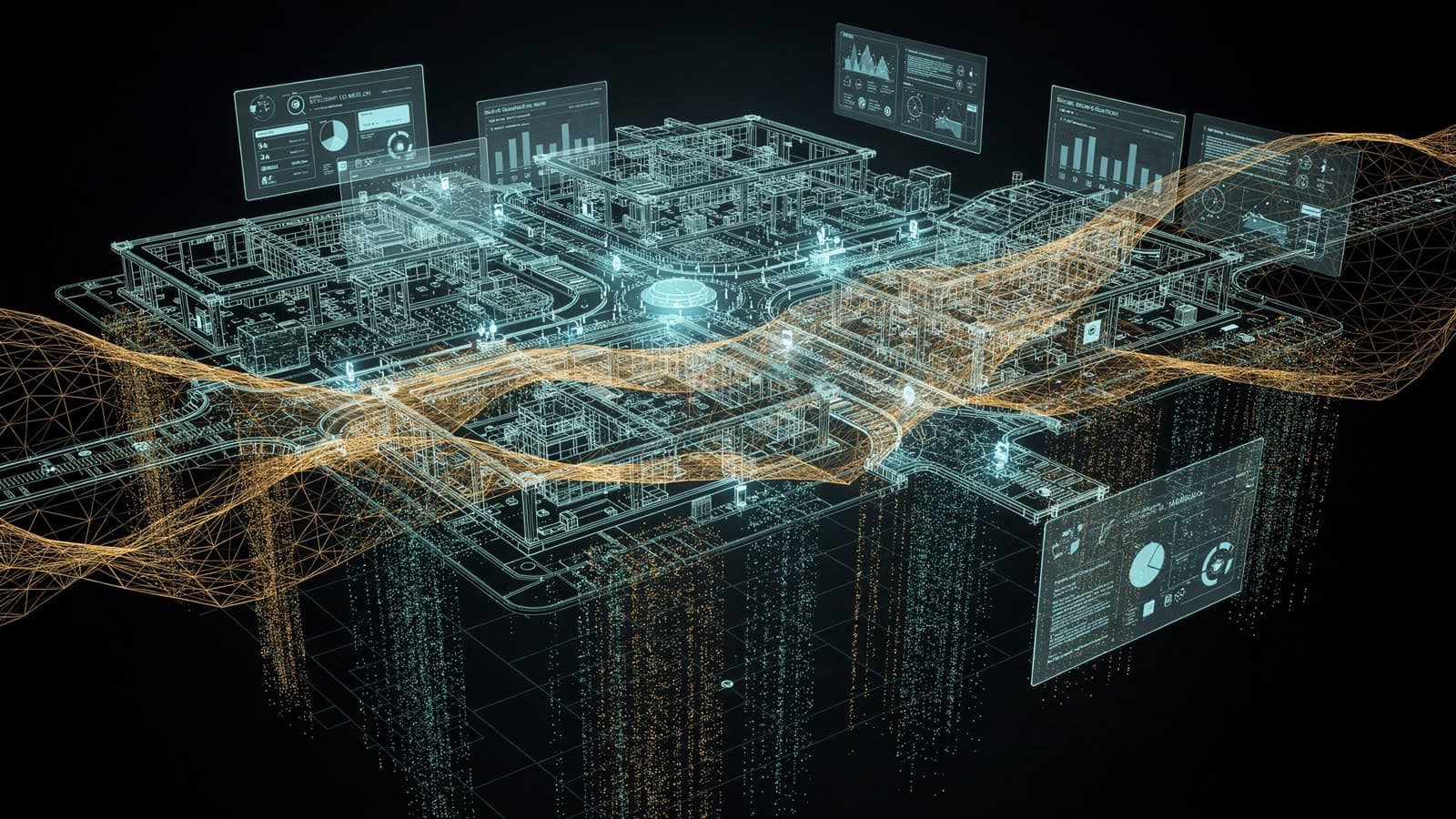
Honeywell Technologies built Forge Cognition to sit on top of existing building management systems rather than replace them. The platform organizes live asset data and telemetry into a shared knowledge base, then runs specialist agents on top: an alarm agent to classify and verify building alerts, asset-health agents to monitor HVAC equipment for mechanical degradation, and digital-twin simulations to evaluate energy scenarios before operators commit to them.
Three modes, manual, semi-autonomous, and autonomous, let facility teams dial how much decision authority the system holds. Honeywell CTO Suresh Venkatarayalu said autonomous mode hasn't been turned on: "We have not opened up an autonomy right now. Maybe we will start running in this mode for probably next two to three years."
The Pilot at NVIDIA Voyager
The most detailed public proof of the platform came from NVIDIA's Voyager campus in Santa Clara, a 750,000-square-foot headquarters with roughly 900 monitored pieces of equipment. Honeywell ran a 90-day project starting in January 2026, targeting Voyager's security and access-control system, which had been generating false alerts between 90% and 95% of the time.
Honeywell trained NVIDIA's open-source Nemotron language model on its own engineering knowledge base to separate genuine alarms from noise. The alarm agent drove a reported 90% reduction in unnecessary alerts while the comfort score across the building stayed above 95%. Digital-twin analysis of heating operations, which had previously run at a fixed 58 degrees year-round regardless of outdoor temperature, identified close to 10% in potential utility savings.
Technology Stack
Dell Technologies supplies compute and storage infrastructure through its AI Factory program, with PowerEdge XE servers, an AI Data Platform, and built-in cyber resiliency features at the core of each deployment. NVIDIA contributes Nemotron open models for the reasoning layer, Omniverse libraries for physically accurate digital twin simulations, Cosmos models paired with its Metropolis Visual System Solutions Blueprint for computer vision, and RTX PRO GPUs with DGX Spark units for edge inference.
The edge-first architecture matters practically. A system managing live HVAC and security decisions needs response times measured in seconds. Running inference close to the building keeps latency within operational tolerances.
Pilots and Availability
Honeywell is running the platform across 6 named pilot sites: NVIDIA Voyager in Santa Clara, the Fairmont Hotel in Dubai, NEX Mall in Singapore, Vanderbilt University, and Honeywell's own campuses in Bangalore and Richardson, Texas. The company has said it plans to expand to 12 additional test sites across 12 industries.
Customers can engage Honeywell today to scope deployments. Pricing wasn't disclosed at launch.
Autonomy on a Timer
Venkatarayalu's stated condition for enabling autonomous mode is "10 out of 10 accuracy all the time." Until that bar is met, the platform advises while operators decide.
The 6-site pilot footprint spanning commercial hospitality, retail, higher education, and corporate campuses appears designed to build the operational record that eventually justifies crossing that threshold. When that happens, the system can move from recommending changes to executing them on its own.
Sources
- Honeywell Technologies Launches Forge Cognition with NVIDIA and Dell Technologies, Honeywell Press Release
- Exclusive: Honeywell Technologies launches a 'brain behind the building' with Nvidia and Dell, Fortune
- Honeywell Launches Forge Cognition Building-AI Platform With Nvidia and Dell, AI Weekly
- Agentic Facility Operations and Digital Twin Simulation, Smart Building Magazine
- Honeywell launches new building management AI platform, Urgent Communications
Companies mentioned
Mainstay Digital · Spatial and 3D visualization for industrial companies