

Guides
3D Product Videos for Industrial Manufacturers
How industrial manufacturers turn CAD into product video, interactive 3D, and Web AR that keeps selling after the booth comes down, on one published subscription.
Mainstay Communications Team · · 6 min read
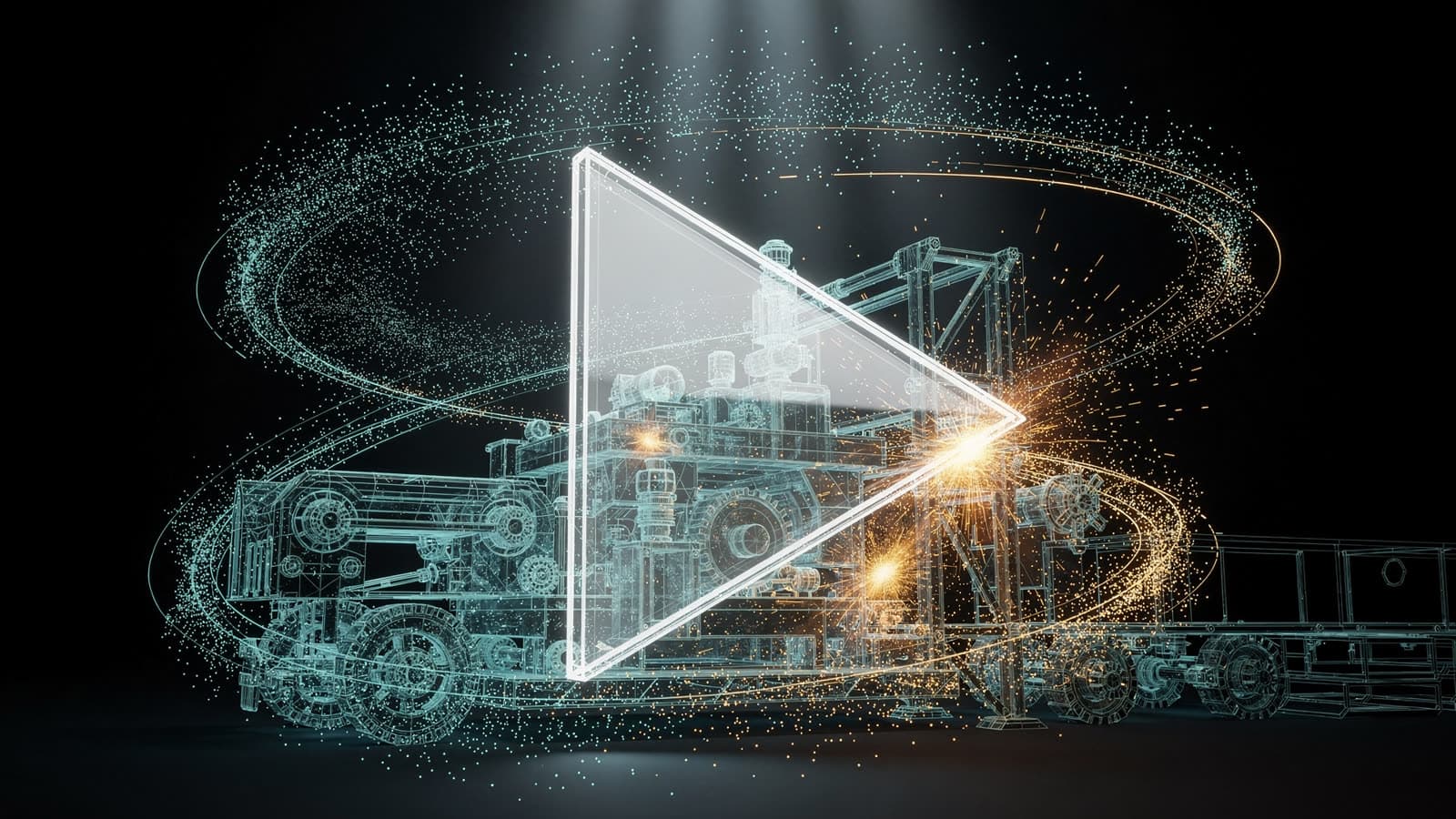
In brief
Industrial product video works best built from engineering CAD, not reshot for every launch. A single 3D master from a STEP file carries across renders, video, Web AR, and interactive 3D, and feeds sales, the website, and the trade show at once. [Mainstay Digital](/) delivers that through Mainstay One, the only subscription in industrial 3D with pricing published openly, starting at $2,995 a month.
Why industrial product video is different
Most product-video advice is written for things that fit on a table. Point a camera, light it well, cut to music. Capital equipment doesn't cooperate. A palletizer, a fill-finish line, or a die bonder is big, often bolted into a customer's plant, and frequently sold before the first unit ships.
So the thing a buyer most needs to see is the thing a camera can't reach. The internal mechanism. The guarding that comes off for service. The same base machine in three configurations. The throughput at line speed. You can't shoot any of that on a live production floor without stopping production, and you usually can't shoot it at all before the launch date you're trying to hit.
That gap is where 3D earns its place. When the video is built from the CAD model instead of a physical unit, the camera goes anywhere. Through a housing. Inside a cabinet. Above the line looking down. The cutaway and the exploded view, the two shots industrial buyers actually ask for, become a modeling decision instead of a logistics problem.
From CAD to content that sells
The practical path looks like this, and it only has to happen once per product.
Intake. You hand over the engineering file. STEP, IGES, SolidWorks, NX, Inventor, Creo. The model that already exists.
The 3D master. That file gets rebuilt into a marketing-ready 3D model with clean geometry, real materials, and correct scale. This is the asset everything else comes from.
The outputs. From that one master you get photoreal stills that replace a photo shoot, a 60 to 90 second product video with voiceover, Web AR so a buyer can stand the machine on their own floor at true scale with no app, and interactive 3D they click through themselves.
Publish. The interactive and AR experiences go live through Brizo and drop into your site, a booth iPad, or a QR code on a spec sheet. Engagement data tells you which features buyers open, so you learn what sells.
The reason the order matters: the slow, expensive step is building the master. Once it exists, a new video, a new render, or a new configuration is cheap. Companies that treat each launch as a fresh shoot pay that setup cost every time. Companies that build the asset library pay it once.
When a subscription beats a one-off
A one-off launch video ages the day the product does. The configuration changes, a new model drops, the show rotates, and the five-figure launch video becomes a liability you'd rather not loop at the booth.
Industrial selling runs on a calendar. Automate, PACK EXPO, IMTS, MD&M, and the regional shows in between. Each one wants current content, and the sales team wants something new to send between them. That cadence is a poor fit for project-by-project video, where every asset is a new quote, a new timeline, and a new round of CAD hand-offs.
A subscription fits the calendar better. The model library already exists, so a show date becomes a planning question instead of a production scramble. Need the new SKU rendered for PACK EXPO, a teardown video for the sales deck, and an AR version for the booth. Same master, three outputs, one monthly price finance can plan around in place of three separate project bids. That is the case for treating 3D as infrastructure the sales team draws on, not as a series of one-time campaigns.
How Mainstay approaches it
Mainstay Digital is a 3D visualization platform for industrial and manufacturing companies, based in Plano, Texas, with a US-based in-house pipeline and no overseas hand-offs. The team has delivered more than 1,250 assets to over 150 industrial brands, including Kawasaki Robotics, KUKA, Baxter, Boon Edam, and Pearson Packaging.
The model is deliberate. You bring the STEP file, Mainstay builds the 3D master and the outputs, and a first draft lands in about two weeks. Mainstay One is the subscription that keeps that output coming: renders, video, Web AR, and interactive 3D on a schedule you can plan around. Pricing is published openly, starting at $2,995 a month, which is rare in a field where almost everyone hides behind "request a quote."
Once the model exists, your team can edit hotspot text, spin up variants, and duplicate experiences through the platform without routing every change back through a vendor. The assets publish through Brizo, and the analytics show which callouts buyers open most.
One tradeoff worth naming honestly: browser and AR models give up the last few percent of shadow and texture in exchange for running anywhere with no install. For hero content you want the fully rendered video and stills. For a buyer exploring on their own, the interactive model wins because they control it. Most industrial companies need both, and both come off the same master.
Frequently asked questions
What is an industrial 3D product video?
It's a product video built from a CAD model instead of a camera shoot. Because the machine is virtual, the video can show internal mechanisms, cutaways, exploded views, alternate configurations, and the product running at line speed, shots that are hard or impossible to capture on a physical unit. It's used for booth loops, sales decks, and product pages.
Do we need new photography or a reshoot for every SKU?
No. The slow step is building the 3D master from your CAD once. After that, a new SKU, a new configuration, or a new camera angle comes off the same model without a reshoot. That reuse is the main cost advantage of 3D over repeated video production.
How is this different from hiring a general video agency?
A general video crew shoots what exists in front of a camera. An industrial 3D platform works from your STEP file, so it can show the inside of the machine and configurations that aren't built yet, and it keeps the model on file so the next asset is fast. Accuracy matters too: the model has to match the engineering, not just look good.
What is Mainstay One?
Mainstay One is Mainstay Digital's 3D subscription. Instead of quoting each asset as a separate project, it keeps a steady pipeline of renders, product video, Web AR, and interactive 3D running against a published monthly price, starting at $2,995 a month. It is built for manufacturers who need current content across a trade-show calendar rather than a single launch video, and the pricing is listed openly instead of behind a quote form.
Where do the finished assets go live?
Photoreal stills and video drop into your website, spec sheets, sales decks, and booth loops. Interactive 3D and Web AR experiences publish through Brizo and embed on your site, run on a booth iPad, or open from a QR code at true scale on a buyer's own floor, with no app download. Engagement analytics show which features buyers click most.
Mainstay Digital · Spatial and 3D visualization for industrial companies