

Complex Products, Clearly Sold
5,000 Products, Almost No Photos: The Catalog Problem Behind Slow Sales
When your product line runs to thousands of SKUs across a dozen frame sizes, a photo shoot doesn't solve it. Here's what does.
Kelly Massad, Co-founder, Mainstay Digital · 7 min read
There's a version of this problem that every industrial manufacturer eventually runs into. Your catalog has grown to the point where full photography coverage is physically impossible. The photos you do have are the wrong size, the wrong frame, or the wrong era.
So the buyer, who needs to spec a replacement part or approve a purchase order, is working from a stock image that doesn't represent what they're actually buying.
The gap between what's in the catalog and what shows up on the loading dock is a confidence problem. Buyers who can't picture what they're ordering introduce friction into every decision.
I keep seeing this in the industrial market, specifically in product lines where the same basic form scales dramatically across a family. A variable frequency drive that covers light commercial HVAC and a heavy industrial installation might look identical in a thumbnail.
They're not identical. The difference matters. And if you can't show it, you're asking the buyer to trust a number on a spec sheet instead of something they've seen.
WorldWide Electric is a Rochester, NY-based manufacturer of electric motors, gear reducers, motor controls, and generators, selling across the US through a distributor and MRO network that covers oil and gas, HVAC, agriculture, data centers, and general industrial. By the account of Michael Hewson, their Director of Marketing, they're a $210 million company.
They carry thousands of SKUs. And they don't have photography of all of them. That's math.
The premium motor line runs across 11 or more frame sizes. Visually, the form is the same motor. It just scales.
The smallest frame is roughly shoebox-sized. Hewson put the scale problem in plain terms: "That frame, that 444 frame, that's actually something probably the size of half a dining table. But that picture there is probably a 10 horsepower motor, not 125."
A 30-model product line, each carrying 12 to 20 variants. That's a photography project that never ends, and even if you funded it, you'd be taking photos of yesterday's product and falling further behind every quarter.
The 3D answer isn't "instead of photos." It's instead of the whole problem.
When WorldWide Electric came to us, the starting point was the STEP and STL files they already had. These are exterior shell models built to NEMA frame standards, the kind shared with OEM customers who need to confirm fit when designing pump skids or conveyor systems.
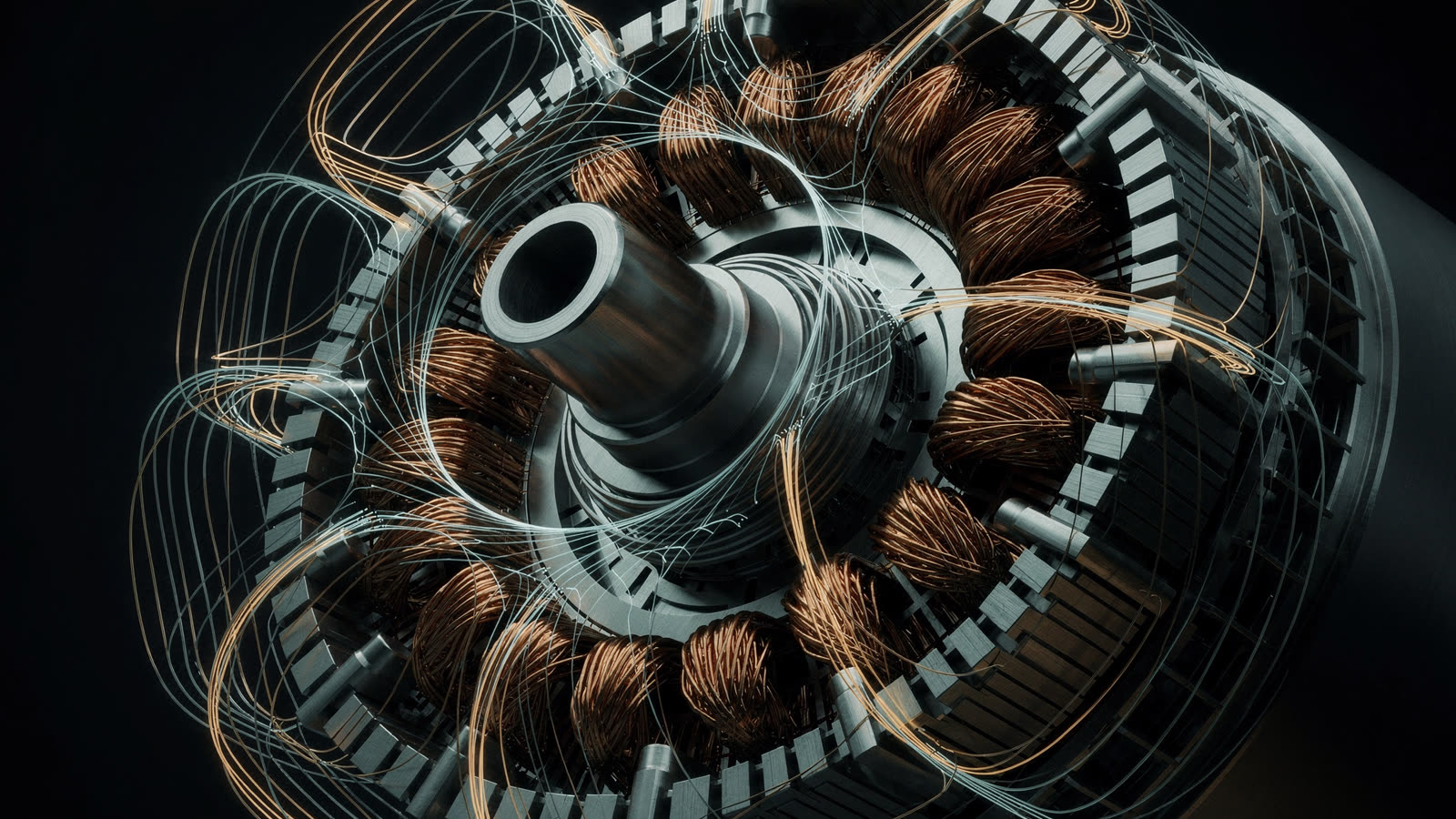
They're not interior assembly models. They don't show windings, bearings, or the stator. That's a real constraint, and we worked within it honestly.
What those files do contain is everything you need to produce accurate, properly lit, correctly scaled 3D representations of every frame size in the line. We took those files and began building photorealistic renders and augmented reality assets for the motor family.
The AR piece is where the scale problem gets solved in a room. Hewson put QR codes on products around the trade show booth. A visitor scans with their phone and a full-scale 3D motor drops into whatever space they're standing in.
You stop arguing about whether the 444 frame is big. You show someone what big looks like, right there on the trade show floor next to them.
Hewson described the reaction from people who understood what they were looking at: "The AR experience, people were like, oh, wow, wow. The CEO is like, damn, yeah, that's cool."
I'll take "oh, wow" from a buyer on a trade show floor.
The platform underneath it
The thing about building a 3D asset correctly once is that it compounds. The hard part is getting the geometry right, the textures right, the scale right. Once that's done, every variation after it is fast.
The platform behind these AR experiences gives WorldWide Electric's team direct control over the deployed links: update a tagline, swap a destination URL, duplicate an experience for a specific distributor meeting or a LinkedIn campaign, track which regions opened it and how long they spent. Palaia walked Hewson through it: "If you've shared these links out into the world, if they open it up again, it's going to show the new one instantaneously for you."
For a marketing team without deep headcount, that matters. You're not filing change requests with a vendor every time the trade show context shifts.
The underlying asset stays the same. The presentation around it is yours to manage.
The bigger opportunity: controls
The motor line was the starting point. But where Hewson's attention really sits is controls.
WorldWide Electric sells variable frequency drives, soft starters, and motor control packages into industrial facilities. There's a rule of thumb inside the business: for every dollar of motor sold, there's about $1.20 in controls sold.
Right now, WorldWide Electric is capturing around 19 cents on the dollar. The gap is the opportunity.
What the controls line needs is different from what motors need. A motor is a physical object. You can spin it, scale it, show it.
A VFD enclosure the size of a refrigerator, mounted in an electrical room, does its work by controlling something else. The visual representation problem is about context, not the object itself.
"What we want on the control side is application videos," Hewson said. "Like you showed us, you're going into a farm and we're seeing it all on the farm. Or you're going across an oil field and all that sort of stuff. That's the type of video that we want."
Showing a 6-foot steel housing next to a mop bucket in an equipment room doesn't sell it. Showing it running an irrigation system across an agricultural operation, or monitoring a data center load, or controlling a conveyor line in a packaging facility, that's what a buyer in those verticals needs to picture. The application video builds the context the product catalog can't.
That work is planned. The engagement paused in mid-2026 with a September restart targeted, contingent on WorldWide Electric's internal team aligning on which products to feature and how to tell the application story.
They're also mid-build on a CRM that will let them track what sales activity actually moves pipeline. When those pieces are in place, the next phase starts.
What this tells me about the catalog problem
WorldWide Electric competes in the MRO replacement market. The buyer is deciding between WorldWide Electric and a competitor whose name is already familiar. WEG, ABB, the large multinationals own the greenfield installation specification.
WorldWide Electric wins when a motor fails and the facilities team needs a fast, reliable replacement.
In that market, visual content that makes a product feel concrete before the sale is a sales tool. A buyer who has seen the 444 frame at actual scale, who has watched the AR experience drop a full-scale motor into the room they're standing in, is a different buyer than one who clicked past a mislabeled stock photo.
They know what they're ordering. That confidence is worth something in a deal.
The attribution question, whether this activity actually moves pipeline, is the right question. It's also the honest question, and it mostly doesn't have an answer yet.
The measurement infrastructure in industrial marketing is still catching up to the tools. Hewson knows this. The CRM comes first, then the attribution loop closes.
What I can say is that the manufacturers building that infrastructure now, getting the 3D assets right, building the AR experiences, tracking engagement while the CRM comes online, are the ones who'll have evidence when that question gets asked in a board meeting. The ones waiting for proof before they start will be looking at a competitor's data.
A catalog with thousands of SKUs and almost no photos is a problem that compounds quietly. Every buyer who couldn't picture what they were ordering is a small friction on a deal.
Over a $210 million revenue base, across a distributor network, across thousands of transactions, small friction adds up. The real fix is building the asset once and letting it work in every room where a sale happens.
Referenced: WorldWide Electric · LinkedIn
Have a complex product that's difficult to explain?
Show us