

Show, Don't Tell
The Best Product Demo Is the One the Buyer Runs Themselves
When a buyer controls the experience, they convince themselves. Scott Automation is testing whether industrial sellers are ready to hand over the wheel.
Kelly Massad, Co-founder, Mainstay Digital · 7 min read
There's a version of the industrial sales call that we've watched fail, in some form, dozens of times. The seller is excellent. The product is genuinely better. The demo is thorough. And still, at the end of the meeting, the buyer says they need to think about it.
What's actually happening in that room is a persuasion asymmetry. The seller controls every piece of the experience, which means the buyer spends the whole meeting processing, not exploring. They can't stop the animation when they see something they don't understand.
They can't click into the one feature their engineer asked about on the flight over. The information flows in one direction, at the seller's pace, and the buyer absorbs what they can.
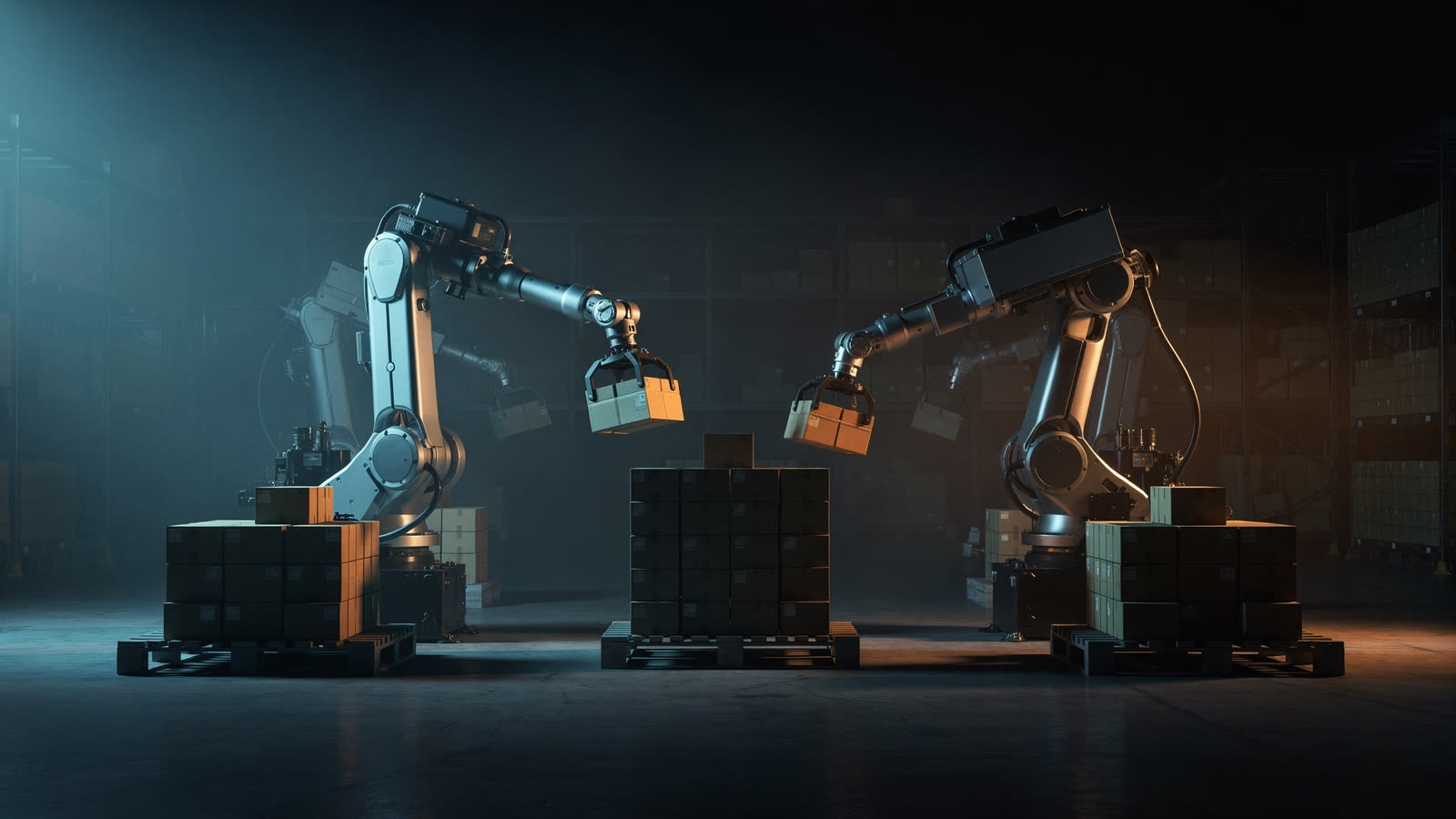
The more complex the product, the worse this gets. A buyer looking at a palletizing system that fills half a factory floor isn't going to internalize that machine from a looping animation and a printed layout. They need to move through it themselves.
I'll give you an example.
Scott Automation has more than 100 years of engineering behind it. Operations across Australasia, China, Europe, and the Americas. They make the kind of equipment that doesn't sell easily: BladeStop, a safety bandsaw that stops a moving blade in under 10 milliseconds, and a deep catalog of palletizing and materials-handling systems.
High-consideration, technically dense, and nearly impossible to evaluate from a photo.
When we started working with Scott in 2026, their sales team was navigating the same friction that makes industrial selling hard in general. Complex machines, long sales cycles, buyers who can't travel to a showroom, and trade shows that put you in, as Scott's own team put it, "the middle of nowhere in some metal building" with no reliable internet.
The direction they chose was to put the machines into interactive 3D and augmented reality. Buyers can rotate the real equipment in a browser, click into the features they care about, and place a full-scale palletizer on their own floor through a QR code. No salesperson driving the experience. The buyer decides where to look.
Scott's international sales director called the first experiences "magic," which is a nice line. But the reason it lands is more specific than that.
The problem the BladeStop demo kept creating
Here's the thing about BladeStop: the obvious way to show it is to show it cutting something. The mechanism is dramatic. A blade moving at speed, stopping in under 10 milliseconds. The instinct is to let it run.
The problem, as Susann Roeder of Scott pointed out, is that if you show a piece of meat, "we're kind of turning off people that are looking at cutting wood or metal." One hero animation quietly narrows your audience. Every buyer who opens that demo and sees the wrong material has already been told something about who the product is for, and it's not them.
The interactive model solves this without a workaround. The machine sits there, turnable, and the buyer chooses what to explore. Cutting application becomes a variant you configure, not a bet you make once for every audience.
The buyer who cares about wood cuts explores that. The metalworking buyer explores something else. Same model. Same hotspots. Different stories, assembled by the person looking at it.
That's genuinely hard to replicate with a static render or a produced video: the buyer's path through the content is their own, which means their conclusion feels like their own too.
Who updates it after you build it
The bigger shift for Scott is control. Who controls the experience, and who can update it.
Steve Palaia, who led the technical build on our side, was direct about what the old model cost sellers: "everything has to come back through us in order to recompile it." Every text change, every updated callout, every version built for a specific show was a change request. A wait. A bottleneck between the sales team and the material they needed.
The self-serve hotspot builder flips that. Palaia was equally direct about where the real work actually lives: "The hardest part is us getting the model. That AR model is the real work of it." We do that part once.
After that, Scott's team goes into the platform and edits callouts, duplicates an experience, spins up a version for the meat-processing audience and a separate version for the woodworking audience, without filing a ticket.
One base model. Many stories. Controlled by the people closest to the customer.
There's a data layer coming on top of this too. These experiences track which hotspots buyers actually open. Once they're live across a few shows and a few sales cycles, that data will tell Scott which feature every buyer goes to first, which is exactly the feature the next pitch should lead with.
Most industrial sellers are guessing at that today. They build content around what their engineers think matters. The click data tells you what buyers actually reach for.
The offline problem nobody talks about
A lot of digital sales tools are built for a demo environment that doesn't exist in the field. Clean signal, reliable Wi-Fi, a screen big enough to do the model justice.
Roeder's description of Scott's real environment was more honest: "Oftentimes we are in the middle of nowhere in some metal building, and not sure if we have internet access there."
So the experiences ship with an offline version that runs on a laptop at the booth. Same model. Same hotspots. No signal required.
It's a small decision that determines whether the tool is usable on the day that matters, or whether it becomes something the sales team stops bringing because it died at the last show.
Building the catalog like Lego blocks
Scott's palletizing systems are the harder project, and the way they're approaching it is worth watching.
A full line is large: accumulation tables, case conveying, pallet handling, palletizers, OEM integration. Every customer's layout is different. Trying to render an entire customer-specific configuration as one AR model would be enormous and mostly wasted.
Roeder's framing was sharper: the systems are "like Lego. They're all the same building blocks," just arranged in different quantities. So the build follows the blocks. Start with one unit, the NextPal 200 palletizer, as a clean AR model with hotspots. Ship it.
A buyer lands on a system image, clicks into the palletizer, and drills into that specific unit. Then add modules over time. New configurations become a matter of relinking existing pieces, not rebuilding from scratch.
It's a practical answer to a real constraint. You can't build everything at once, so you build the pieces that compound. The library gets richer over time and the per-unit investment drops.
What this means if you sell anything a buyer can't picture
Strip the specific machines out and Scott's bet is one that more industrial sellers are starting to make, for a clear reason.
Complex equipment is hard to evaluate on paper. A buyer who can explore it themselves arrives at the next conversation better informed and more committed than one who sat through a presentation. The mechanism is simple: telling someone what a machine does is different from letting them find it.
The quieter implication is about who controls the story. When the sales team can edit, version, and duplicate their own product experiences, marketing stops being a bottleneck between the pitch and the material.
The content keeps up with the conversation. And when the usage data comes back, the loop tightens: you learn what buyers actually care about, then you build toward that.
Scott isn't done with this rollout. One machine at a time, the way real industrial projects go. But the direction is clear enough to be useful regardless of the category you're in.
If your product is difficult to evaluate from a photo, the question is less whether to make it explorable and more where you start, and how you make sure the people closest to the sale can keep it current.
The demo that the buyer runs themselves is a different kind of convincing. Worth building.
Referenced: Scott Automation · LinkedIn
Have a complex product that's difficult to explain?
Show us