

Complex Products, Clearly Sold
When Your Product Is a Component Inside Someone Else's Product
Selling a chip that lives inside a module that lives inside a server requires making buyers see something they will never physically touch.
Kelly Massad, Co-founder, Mainstay Digital · 7 min read
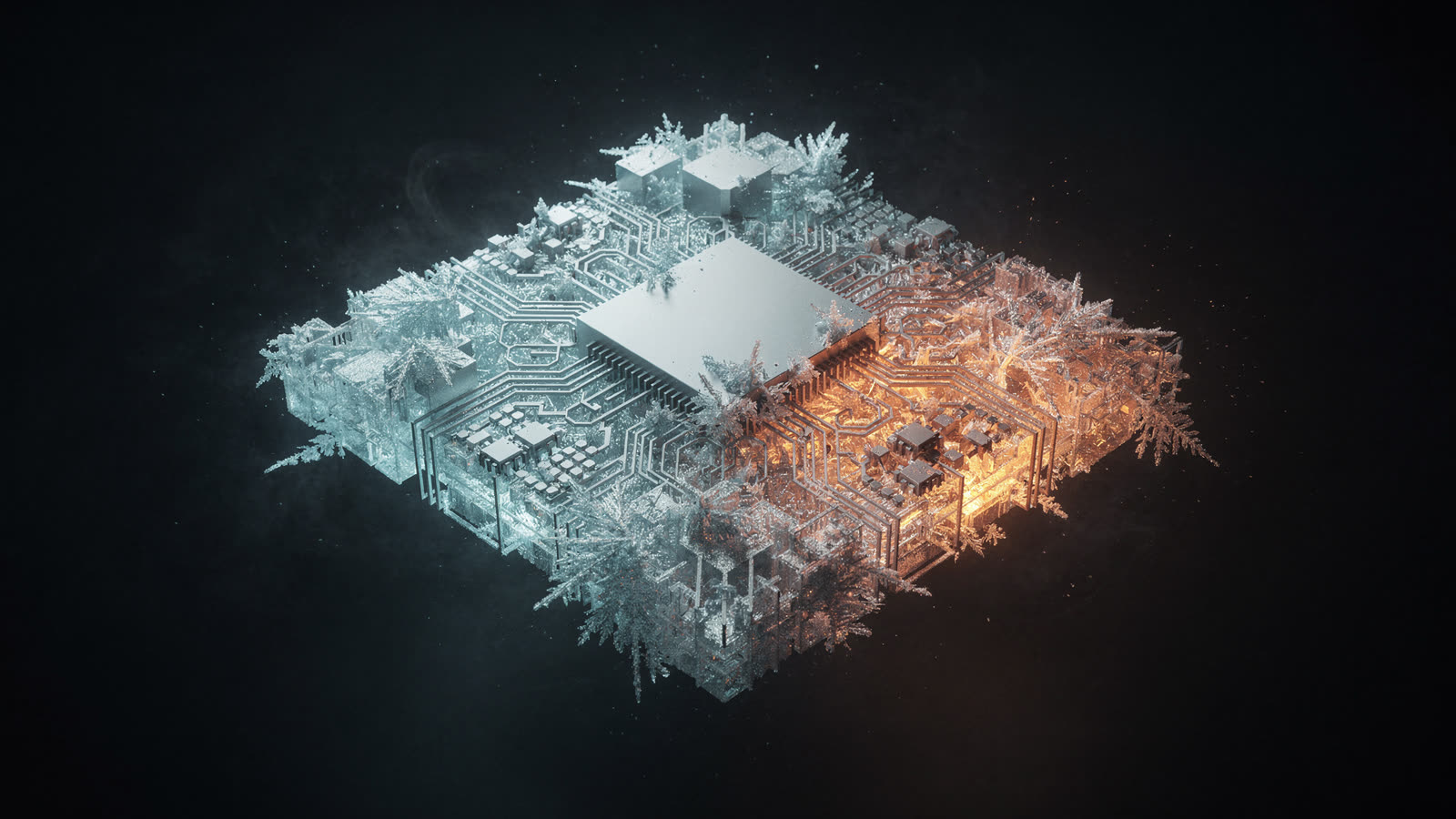
There is a category of B2B product where the sales challenge is almost philosophical. The thing you sell is real, engineered precisely, and genuinely differentiated. But your customer can't see it. Your buyer's buyer might not even know it exists. And the pressure you feel on price comes partly from that invisibility: if a buyer can't distinguish your component from a commodity, they'll treat it like one.
I keep seeing this with deep-tech hardware companies, and it doesn't resolve neatly. Better copy or a cleaner data sheet won't fix it. The proof of performance lives inside a system the buyer doesn't control, in a form that can't be extracted for a trade show or a sales call.
So how do you sell it?
Phononic, based in Durham, North Carolina, makes solid-state thermoelectric cooling devices. TECs. Each one is roughly the size of a thumbnail.
They sit inside pluggable transceivers, GPU memory stacks, and co-packaged optic modules inside AI data centers. Their job is to keep heat under control at the point where it matters most, because when an AI workload spikes and temperature in an HBM stack crosses 85 degrees Celsius, hardware begins throttling.
At 95 degrees, it shuts down to protect itself. Phononic's devices prevent that.
The product is the thing that keeps the thing running. And nobody can see it.
"The little tiny semiconductor chips that we make: they are custom designed, they are highly engineered," said Stephanie Parrish, who leads marketing at Phononic. "And a lot of our Asia customers really hammer us on price."
That's what invisibility costs you. The engineering is real. The advantage is real. But without a way to make buyers see what they're actually getting, price becomes the default conversation.
The phrase Phononic uses internally is "component within a component." Their TECs are embedded inside the GPU, the transceiver, the server. The performance argument only becomes legible when you can show the buyer the relationship between the TEC, its control board, and the temperature curve it manages. That relationship doesn't exist in a photo, because no photo can show you the inside of an assembled co-packaged optic module at the level of resolution that matters.
Here's where it gets genuinely difficult. Phononic's actual product designs are tightly proprietary. They're shared under NDA, and sometimes not even then.
So when we started building visual assets for them, we were working from generic architecture references, internal conceptual models, and what Parrish and her engineering team could walk us through. The x-ray and exploded views that let a buyer see a TEC inside its host component had to be built up from scratch.
Cristian Jimenez, one of our 3D artists, said something after one of those sessions that stuck with me: "Whenever you're explaining it to me, I'm like, yeah, I understand. And then we make the visuals, and I'm like, okay, I guess I didn't understand."
That gap is the whole problem. The product is sophisticated enough that even the people building the visuals need to go through several iterations before they've actually internalized the architecture. If that's true for us, it's certainly true for the engineers and executives on the buying side who encounter it in a 20-minute booth conversation or a one-page leave-behind.
The first major asset we built was a hero brand video called "Before the Heat Wins." It operates at the data center level: AI workloads getting spikier, compute density rising, heat accumulating faster than conventional cooling can respond. It introduces Phononic's Thermal Fabric concept, a software-directed orchestration layer that routes precise cooling to hotspots across the data center at millisecond response speed.
That video needed to carry the story for multiple audiences at the same time. Parrish's buyers include thermal engineers who understand what a TEC is, CEOs who don't, and investors somewhere between the two. The animation had to make the argument without requiring the viewer to already know the product.
The GPU thermal kit animation went in the opposite direction. Where the hero video zooms out, the kit animation zooms in: a closed module that opens to reveal the TEC, the printed control board, the ribbon connectors. Each component gets its moment.
The goal is to make a specific argument about what the kit actually is. The controls are intelligent. The responsiveness is, by Phononic's own account, 600 times faster than a liquid cooling loop reacting to a distant CDU signal. That claim depends on showing the relationship between the TEC and its control board. You can't make it otherwise.
Parrish described what she wanted the animation to communicate: "I want to take this thing that you've already built. You start with the kit, zoom into the tech, tell the tech story, zoom out to tech plus cartridge. Say tech plus cartridge plus embedded controls is the magic sauce."
That animation is now live on the Phononic website. "It's rocking and rolling. People really like it," she said.
The harder problem is what happens after a buyer watches the video. They understand the concept, but the product story keeps moving. Thermal Fabric is new. The language around co-packaged optics is shifting as the underlying architecture matures. A marketing team that has to route every messaging update through a production queue will always be a half-step behind its own market.
In June 2026, we showed Phononic a prototype of a hotspot interactive experience: a 3D model in a browser, rotatable, clickable, with callout panels that explain individual features. The same experience can be viewed in augmented reality through a QR code. Parrish started immediately mapping use cases: a version for GPU cooling kit buyers, a version tailored to hyperscaler procurement, a version for the thermal engineering audience at a conference.
What she flagged as important was the self-serve editing layer. Steve Palaia, who oversees the interactive work on our side, explained it to her this way: "You would have the power to log in and update the text, update images, change the hotspots. You can duplicate it for different use cases. If the product could be used in multiple places, you could go in and tailor the messaging for different applications, different sales teams."
For a company whose messaging is genuinely evolving with its market, that matters more than it might for a company with a stable product line. Phononic's current core business is pluggable transceivers. Co-packaged optics, where the thermal challenge is different, is where a significant part of the future opportunity sits.
One interactive, adjusted for two conversations, without going back through a production cycle each time.
One practical note Parrish raised: Phononic exhibits at events like the AI Infrastructure conference and Supercomputing, where booth experiences have to run on a laptop with no guarantee of venue Wi-Fi. The interactive runs offline. That detail matters more than it sounds when you've had a booth connection fail on you at a show.
The larger interactive in development is built around AI workload data. A buyer chooses a workload type: inference, training, agentic. They watch the temperature curve animate on inside a GPU or HBM stack as that workload runs. Then they watch what Phononic's thermal management does to that curve.
Parrish described the concept in a May 2026 session: "It's like a choose your own adventure. You need to run a training workload: what does that look like? What does it look like as far as heat management? And what does precisely managing that heat mean? Well, it means you can crank out more tokens."
That asset is targeted at the AI Infrastructure event in September 2026 and Supercomputing in November. Phononic is finalizing the temperature curve data from engineering. The storyboarding has started.
Pull back from the specifics and Phononic's situation describes a real pattern. The product is sophisticated and embedded inside something else. The buyer is technical but not uniform. The CAD that would make the whole thing obvious can't leave the building. And the messaging is still being refined because the market is still being defined.
The old answer was a spec sheet and a field engineer who'd seen it all before. The newer answer is a visual library the marketing team can own, experiences a buyer can drive themselves, and content architecture flexible enough to carry a different story for the next conversation than it carried for the last.
The component is smaller than a thumbnail. But the argument for why it matters runs the whole length of the AI compute stack. Making that argument visible is, itself, an engineering problem.
That's the part of the product that still needs to be built.
Referenced: Phononic · LinkedIn
Have a complex product that's difficult to explain?
Show us