

Inside the Machine
We Helped Launch a Machine Without a Booth. Here's What Replaced It
When a 70-year-old packaging equipment maker skipped PACK EXPO and handed its sales team QR cards instead, something interesting happened at the buyer's end.
Kelly Massad, Co-founder, Mainstay Digital · 6 min read
The trade show booth is a financing decision as much as a marketing one. Space fees, freight, drayage, setup, hotel rooms, staff time. For a packaging equipment maker running a product launch with a marketing team of one director and 2 interns, the math is difficult to ignore.
Even when you can afford the booth, there's a question worth asking before you sign the contract: is being present at a show the same thing as being present with the buyer?
We've been working on this question with a few industrial equipment companies over the past couple of years. The most concrete test of it is a launch we're in the middle of right now.
The Machine and the Problem
Pearson Packaging has been engineering automated case erecting equipment out of Spokane, Washington since 1955. They know the product.
The CE30, their newest case erector, has a genuine differentiator over its predecessor: glass side panels and an open top that give operators full visibility into the machine's operation. That's a real engineering decision with real workflow implications. It's also the kind of thing that disappears in a spec sheet.
Case erectors are machines in enclosures. A photograph of one looks like every other photograph of one. The CE30's visibility design, which Richard Fordham (who leads marketing at Pearson) described as "the next gen generation of case erecting," needs to be seen to land. Getting a production machine in front of every qualified prospect in every food and beverage plant across the country isn't a realistic plan.
So they built a different plan.
What the Sales Rep Carries Instead
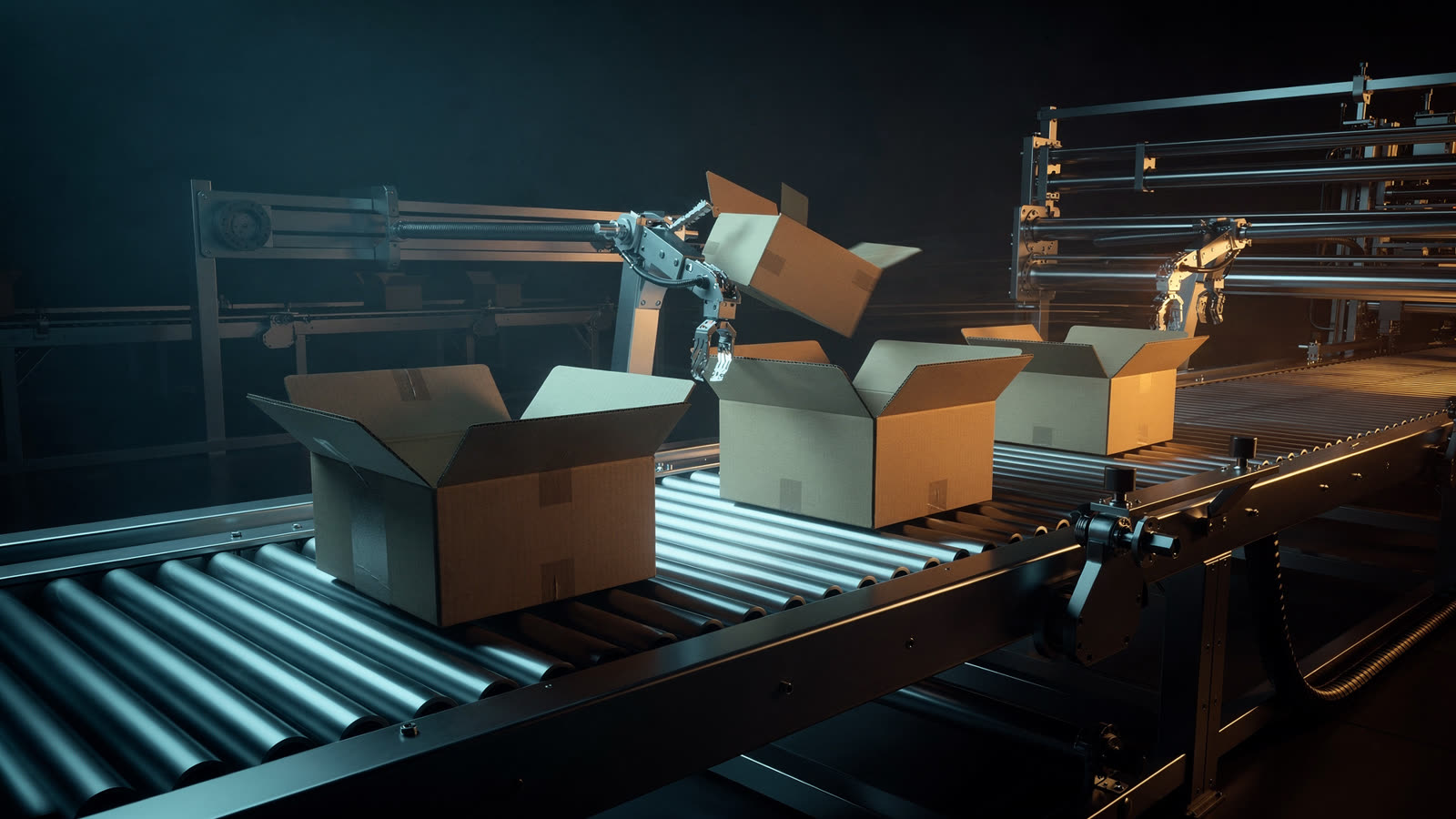
The leave-behind Pearson has been deploying is a QR card. The buyer scans it. A full-scale CE15 or CE25 appears on the plant floor in augmented reality, through the camera on their phone. Rotate-able, zoom-able, placeable next to their actual conveyor line. No app download. No headset. No booth.
Fordham described what they found once the team started using the AR cards in the field: "The sales team does have the CE15 AR cards, gave those off to them, and they are using it as they visit facilities as leave-behinds."
Leave-behinds that work at a facility visit in Spokane and at a quick meeting in Delaware. Leave-behinds that stay with the buyer after the rep walks out.
The card sits on the buyer's desk. The machine sits on the buyer's floor whenever they want to put it there.
We've built AR models for the CE15, CE25, and now the CE30. Layered on top of those are hotspot experiences with clickable feature callouts.
The CE30 launch also includes a splash video in production and a catalog of personalized pitch assets. The stack is deeper than a single piece of collateral, but it starts with that QR card.
What Buyers Actually Click
Here's something a brochure has never been able to tell a product marketer: which feature the buyer goes to first when they can go anywhere.
The hotspot experiences generate click-level analytics. During one of our review calls with Pearson, we pulled up the data on one of their existing machine experiences. The most-clicked feature, ahead of specs, ahead of the enclosure design, was "fast changeover."
That's signal. Not a survey, not a focus group. Buyers navigating on their own time, clicking what they actually care about.
For a company launching a machine whose key differentiator is operator visibility, knowing that fast changeover is what buyers reach for first shapes how you write the CE30 hotspot copy. You lead with what moves the deal.
The platform also tracks session time by geography. In one call, we showed Fordham that someone in Seattle had viewed the CE30 AR experience for almost 22 minutes. A 22-minute session on a QR-code-accessed AR machine experience isn't casual browsing.
That's a buyer doing real evaluation. The fact that it happened while Fordham was presumably doing something else entirely is part of the point.
A 3-Person Team Reaching Hundreds of Thousands of Companies
Fordham was direct about the constraint he's working inside: "There's hundreds of thousands of companies that need our solution. Right?" He has 2 interns and himself.
The traditional content operation at a company like Pearson routes every change back through a vendor or an internal design resource. New product spec? File a ticket. Campaign-specific QR code for a specific show? File another ticket.
For a team this size, that bottleneck's a real problem.
The self-serve platform we onboarded Pearson into during one of our July calls changes that arithmetic. Fordham can duplicate an experience, update the copy, swap in a new tagline, and the changes propagate everywhere the link exists.
Short codes let him create tracking links for LinkedIn, for specific shows, or for individual prospects. QR codes download in seconds. When he updated Pearson's brand color to their "blurple" live on the call, it updated across every published experience immediately. His reaction: "It's all dynamic."
The capability that got the most visible reaction was prospect mode. The platform takes a prospect's website URL, pulls context from it, and automatically reframes the hotspot copy around that company's specific application.
A pitch to a cereal manufacturer reads differently than a pitch to a beverage packer. Fordham saw the first output and said, "Love the personalization." His immediate instinct was to edit it himself, add in what he knew about that prospect's specific line speeds, and send it.
That's account-based marketing at a scale a 3-person team can actually run. No additional headcount. No agency retainer per campaign. One person who knows the product better than anyone, with tooling that multiplies how many buyers he can reach with a message that sounds like it was written for them.
What Skipping the Booth Is Actually a Bet On
Pearson's move isn't anti-trade-show as a philosophical stance. PACK EXPO is a real event with real ROI for exhibitors who are set up to convert floor traffic. The bet Pearson is making is more specific: that presence at the buyer's location, on the buyer's schedule, is worth more per dollar than presence at a show.
The AR card works at 2pm on a Tuesday when the plant manager has 20 minutes between production runs. The booth works during a 3-day window in Chicago once a year, if the buyer makes it to the show, finds the booth, and has time to stop. Those are different kinds of coverage.
The data loop is what makes the digital approach sustainable over time. You're not guessing what buyers care about. You're watching what they open, how long they stay, where they drop off.
The content gets built toward what actually moves the deal, not toward what the product team thinks should move the deal.
Fordham made the ambition clear when talking about what the CE30 launch needs to accomplish: "We want this to be as robust as possible, splashy as possible." That's a product introduction competing for attention in a category where most vendor outreach is a PDF and a phone call.
The CE30 hotspot experience was still in production as of mid-2026. The splash video was queuing up. Fordham's team was working through engineering to get HMI screen recordings for the interactive callouts.
Real industrial projects go in iterations. But the direction is set: a launch that travels with the sales team, generates data on what buyers actually want to know, and scales to a market that's too large for any 3-person team to reach the traditional way.
The buyer in Seattle who spent 22 minutes with the machine didn't wait for a trade show. The machine came to them.
Referenced: Pearson Packaging · LinkedIn
Have a complex product that's difficult to explain?
Show us