
Explainers
What Is Always-On 3D Marketing for Industrial Brands
Always-on 3D product marketing is a persistent library of product assets that stays published. Here's how it educates buyers and supports sales.
Mainstay Digital · · 5 min read
Short answer
Always-on 3D product marketing is a persistent library of 3D product assets that stays published and keeps producing new ones, so a buyer can explore a machine in 3D on any day, with or without a rep in the room. For industrial brands it educates buyers before the first call, gives sales something to open during it, and extends engagement past the live demo. Mainstay One runs it as a subscription from $2,995 a month plus a one-time $2,500 onboarding fee, with 1 to 3 assets in production at a time depending on the plan.
Always-on 3D product marketing means your product's 3D assets stay published all year, and a production pipeline keeps adding stills, Web AR, hotspots, video, and interactive builds on a steady cadence. A campaign produces a burst of assets around a launch. An always-on program produces a library that grows and stays open to buyers.
What does always-on 3D product marketing mean for an industrial brand?
It has 3 traits.
It stays published. Digital product assets live at links, QR codes, and embeds that buyers can open any day, on a phone, a laptop, or a floor iPad.
It keeps producing. The pipeline works 1 asset at a time on Basic and Immersive, and 3 at a time on Momentum. Each finished asset makes room for the next.
It reuses 1 master. The 3D model gets built once from your STEP file. Stills, Web AR, hotspots, video, and interactive 3D all come off it.
How does it differ from a campaign burst?
| Campaign burst | Always-on library | |
|---|---|---|
| When buyers can find it | During the push | Any day |
| Cost shape | A project quote per asset | The same monthly number |
| Next asset | A new quote, a new timeline, a new round of CAD hand-offs | Queues behind the last one |
| Between shows | The launch video ages with the product | Sales has something current to send |
Industrial product marketing runs on a calendar: Automate, PACK EXPO, IMTS, ProMat, and the regional shows between them. Industrial marketing content that's already built turns each date into a planning question.
How does always-on 3D educate buyers?
Complex equipment hides what sells it. A sealed housing, an alternate configuration, and a line running at speed are all hard to photograph. Labeled hotspots, true-scale Web AR, and interactive 3D put those things in front of the buyer at their own pace. That's the job of 3D visualization.
Pearson Packaging shows what that looks like at scale. Trade show economics keep getting worse, so Pearson moved to a choose-your-path interactive 3D experience spanning 27 machines, each a self-guided walkthrough of components, steps, and features. Buyers spent 2x the time versus static formats, and 50% engaged the interactive walkthroughs.
Consistency teaches too. Microdrones replaced outdated photos and stock imagery with a library of photoreal renders matched to exact specs, and saw a 40% increase in perceived credibility.
How does it support the sales team?
A rep with an always-on library carries the machine in a pocket. They open interactive 3D on a live call, send a Web AR link after it, or hand across an AR QR business card (included from Basic up). Pearson saw a 54% conversion lift with video.
Hotspot analytics, included from Immersive up, show which callouts buyers open. A rep who knows buyers keep opening the control cabinet can lead with it on the next call.
Microdrones also reported 25% faster decisions once buyers saw consistent product imagery at the decision stage.
How does it extend engagement past the live demo?
A live demo ends when the rep hangs up or the booth closes. A published asset keeps working.
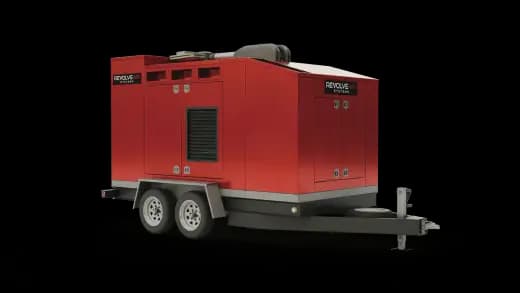
MES Fire's RevolveAir fill station is trailer-sized, so shipping it to shows was slow and costly. We built a web-based AR experience that prospects open from a QR code, with no app to download. The numbers: a 7+ minute average session, 5 countries reached, 100+ cities engaged, and 3.15 views per user.
Tidel's TR400 cash recycler works the same way. The self-guided 3D experience doubled average dwell time and got reused past the show for year-round value, including training.
What does the subscription look like?
Mainstay One is the subscription behind it, and it covers product visualization from stills to interactive 3D. All 3 plans include unlimited access to Brizo.
- Basic, $2,995 a month. Unlimited product stills and Web AR, AR analytics, AR QR business cards, 1 asset at a time. Product videos use the Basic edit, with no voiceover or custom soundtrack.
- Immersive, $3,995 a month. Everything in Basic, plus full-production video with voiceover and scored music, hotspot 3D experiences, and hotspot analytics. 1 asset at a time.
- Momentum, $7,995 a month. Everything in Immersive, plus custom interactive experiences and 3 assets at a time.
Each plan carries a one-time $2,500 onboarding fee, and you can cancel anytime with 30 days notice. Finance sees the same number every quarter.
If you'd like to see the plans side by side, they're in the pricing section.
Frequently asked questions
How is always-on 3D different from a one-off 3D render?
A one-off render is a single finished asset from a single project. Always-on 3D is the library and the pipeline behind it: many assets built from the same master, published and refreshed over time. The first costs a quote each time, and the second costs a flat monthly price.
Do buyers need to install anything to use it?
No. Web AR runs in a phone browser with no app, and interactive 3D opens on the web, a booth screen, or a live call. Most of the return comes from this web-based side: renders, interactive 3D on your site, and Web AR.
How many products do we need to get started?
Just 1. A single STEP file starts the library, and the machine your reps demo most is usually the right first pick. Add the rest of the line as the pipeline frees up.
Who uses it inside a manufacturer?
Product marketing orders and owns the library. Sales enablement puts the assets in decks and reps' hands, trade show managers carry them onto the floor, and dealer reps open them on calls.
Is it worth the cost for a smaller product line?
1 booth runs $50K to $150K for a week, and a 3D library keeps working after the show closes. Tidel's TR400 experience saved $12K per event and doubled average dwell time. A smaller line can start with 1 product and 1 STEP file.