
Guides
The Complete Guide to Remote Equipment Evaluation
Industrial 3D content lets buyers judge capital equipment remotely: stills, Web AR, hotspots, and interactive 3D, stage by stage, before a plant visit.
Mainstay Digital · · 6 min read
Short answer
Industrial 3D content lets a buyer judge a machine's look, true-scale footprint, inner mechanism, and workflow from a browser or phone before anyone books a plant visit. Each format answers a different question: stills for the first look, Web AR for fit, hotspots for how it works, and interactive 3D for how an operator runs it.
B2B buyer evaluation of capital equipment runs through 4 questions in order: what is it, will it fit, how does it work, and how would we run it? Industrial 3D content answers each one, so a buyer arrives at the plant visit with the basics settled and a short list of real questions.
How does industrial 3D content help B2B buyers evaluate capital equipment before a site visit?
A plant visit costs a buyer travel, calendar time, and a few favors. Operations engineers, procurement leads, and executives all want the basics settled before they book it. A pre-visit product assessment is the work a buyer does remotely before booking travel, and industrial 3D content gives that work something to look at.
The assessment covers 4 questions:
- What is it? A clean look at the machine, its finish, and its welds.
- Will it fit? Footprint, height, and clearances on their own floor.
- How does it work? The mechanism behind the guarding.
- How would we run it? Operator workflow, step by step.
Some buyers never make the trip. Yaskawa's case study describes C-suite buyers who never walked the trade show floor. For buyers like that, remote content may be the only version of the machine they see.
Which 3D format answers each stage of the buyer journey?
3D product visualization built from 1 STEP file feeds all 5 formats below.
| Buyer stage | Question the buyer asks | Format | Mainstay turnaround |
|---|---|---|---|
| 1. First look | What does it look like, and is this a serious supplier? | Product stills | 1 to 2 weeks |
| 2. Fit check | Will it fit on our floor? | Web AR at true scale | 3 to 4 weeks |
| 3. Mechanism | How does it work inside? | Hotspots | 3 to 4 weeks |
| 4. Operation | How would our operator run it day to day? | Interactive 3D | 4 to 8 weeks |
| 5. Internal sell | Can I show this to the people who sign? | Product video | 4 to 6 weeks |
All 5 come off 1 3D master. The master is the slow step to build, and every format after it reuses that work.
Can Web AR show a machine at true scale before anyone visits?
Yes. Web AR puts the machine in the buyer's own space at true scale, from a QR code, in a phone browser, with no app to download. Capital equipment visualization at true scale answers the footprint question directly.
Mainstay built Yaskawa's Web AR around the PL-Series palletizing robot, a 4-axis line with payloads from 80 to 800 kg. Attendees opened a full-scale robot on their own phones. The results were 66% higher engagement than traditional methods, 30% better lead quality, and a 5:1 return on investment.
MES Fire's RevolveAir fill station is trailer-sized, so shipping it was slow and expensive. Mainstay built a web-based AR experience, and a QR code on a card, at an event, or in an email now opens the interactive 3D station.
Sessions average 7+ minutes, and the experience has reached 5 countries and 100+ cities at 3.15 views per user. Shipping costs were eliminated.
How do hotspots and interactive 3D show what's inside the machine?
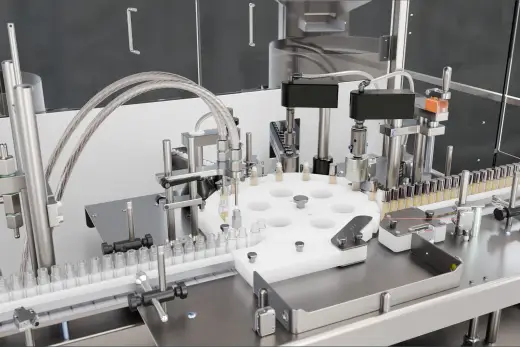
The parts that sell a machine sit behind housings. Labeled hotspots walk a buyer through the mechanism step by step, with no teardown. Mainstay has built hotspot walkthroughs for the NexPAL 200HL robotic palletizer, the Orion CTS twin-station stretch wrapper, and the Scott BladeStop safety band saw, where the blade stops in under 10ms.
Interactive 3D goes further and lets the buyer run the machine. Tidel's TR400 cash recycler weighs 1,000 pounds, and its workflows run from shift management to cassette handling.
Mainstay built a choose-your-path simulation where visitors explore the interface, the components, and the workflows at their own pace. It saved $12K per event and doubled average dwell time.
Boon Edam's interactive ecosystem drew 52% engagement versus 36% for static formats, with sessions 3 to 4x longer. Pearson Packaging deployed 27 machine walkthroughs, and 50% engaged with them.
Industrial equipment marketing teams get a second benefit. The same builds run on the show floor, on the website, and on a live call.
What does remote evaluation shorten, and where does a plant visit still matter?
Remote evaluation can shorten the early rounds. In Mainstay's published case studies, Boon Edam's interactive 3D cut 2 to 3 weeks from sales cycles and lowered cost per demo by 35%. Microdrones' photoreal stills brought 25% faster decisions.
A plant visit still matters for what a model can't carry: how a weld looks in person, material handling on your actual line, the service team's response, and the people. Browser and AR models also give up the last few percent of shadow and texture to run anywhere with no install. For finish decisions, use the fully rendered stills and video.
The buyer who arrives with the basics settled spends the visit on the questions only a visit can answer.
How do you build a remote evaluation kit from 1 STEP file?
Run these 4 steps:
- List the questions. Ask your sales reps what buyers want answered before they book a visit.
- Start with stills and Web AR. Every Mainstay plan includes unlimited product stills and unlimited Web AR, starting at $2,995 a month.
- Add hotspots where the mechanism sells. Immersive, at $3,995 a month, adds hotspot 3D experiences, hotspot analytics, and full-production video.
- Build interactive 3D for long evaluations. Momentum, at $7,995 a month, adds custom interactive experiences and 3 concurrent assets.
Every plan adds a $2,500 one-time onboarding fee and cancels with 30 days notice. Give each rep 1 link per machine, then watch the analytics to see which parts buyers open.
Teams planning a show can pair this kit with our demo-team scorecard. Mainstay has delivered 1,250+ assets to 150+ industrial brands. To start with the machine buyers ask about most, start a request.
Frequently asked questions
Can a buyer see a machine at true scale without visiting the plant?
Yes. With Web AR, the buyer scans a QR code or opens a link and the machine appears at true scale in their own space. It runs in a phone browser, so nothing installs.
Do buyers need an app or a headset to evaluate equipment in AR?
No. Web AR runs in a phone browser. Most of the return on industrial 3D comes from web-based formats: photoreal renders, interactive 3D on your site, and Web AR.
Which 3D format should a manufacturer build first for remote evaluation?
Start with product stills and Web AR. Stills take 1 to 2 weeks on Mainstay's published turnarounds, and Web AR takes 3 to 4 weeks. Together they cover the first look and the fit check.
How can I tell which parts of a machine buyers care about?
Use analytics. AR analytics come with every Mainstay plan, and hotspot analytics come with Immersive and Momentum. MES Fire's 3.15 views per user shows the kind of signal to watch.
Does remote evaluation shorten the sales cycle?
It can. In 1 Mainstay case study, Boon Edam's interactive 3D cut 2 to 3 weeks from sales cycles. Results depend on the product and the buyer, so track your own cycle length before and after.